Small cosmetic studies of topical GHK-Cu formulations have reported improvements in skin’s look and feel (including firmness), elasticity, smoothness and the appearance of fine lines. It appears to tell cells (especially fibroblasts), to shift into a more active maintenance mode. That’s a plausible mechanism (and it’s where a lot of online content stops), but a mechanism in a dish only tells you what a molecule can do, not what it does in your skin at the dose in a bottle or a syringe. Maquart et al. showed that GHK-Cu applied to standardized wounds in rats significantly increased collagen deposition and overall wound contraction speed compared to controls .
One of the factors that piqued researchers’ interest in external supplementation is this. The changes in tissue repair related to aging mirror this decline. Every compound page on this site (including the one about GHK-Cu), is researched, written, and reviewed by the team. Although human evidence is available, it is confined to small cosmetic trials, leaving the effect size on actual skin largely unverified.
For the look of fine lines, a product with a way past the surface is a reasonable experiment. GHK-Cu has a long lab record and thin human evidence. One window or one lamp — at the same time of day.
Studies involving humans (topical)

In 2026 — the supplement guidance from USADA was expanded to mitigate that risk. Every substance present in their samples is the responsibility of athletes, even those obtained through contaminated supplements. While certain risks can be reduced through independent testing, such measures cannot guarantee clinical efficacy or entirely eliminate risks.
Regeneration of hair follicles and growth
According to Pickart and Margolina — bioinformatic analyses show that GHK-Cu influences the expression of over 4,000 human genes, including those associated with collagen production, anti-inflammatory processes, and DNA repair. Data from human randomized controlled trials over several decades indicates that tretinoin , all-trans retinoic acid, reduces fine lines, enhances skin texture, and increases epidermal thickness. The highest risk is associated with sourcing from unverified suppliers.
While mechanistic speculation suggests upregulation of matrix metalloproteinases is dose background for a KPV peptide buying decision -dependent, this remains a hypothesis rather than a confirmed finding. Due to the limited number of human clinical trials designed specifically for hair-density outcomes, assertions about clinical-grade hair regrowth should be interpreted as extrapolations from preclinical data. In a 2024 study published in Bioactive Materials, Liu et al. found that GHK-Cu, delivered via an ionic-liquid microemulsion system, sped up the anagen , growth, phase in mice, achieving results comparable to or quicker than 5% minoxidil in that model. The most compelling human evidence pertains to topical applications on photoaged skin (where controlled trials demonstrated enhanced skin density), thickness, and reduced appearance of wrinkles after 12 weeks of daily use.

A separate small trial found improvements in fine lines. A 2001 study published in Archives of Dermatological Research enrolled 67 women and found that a GHK-Cu-containing cream improved skin laxity (density), and thickness compared to a control cream over 12 weeks. These results are promising for researchers — but animal wound models do not translate cleanly to human cosmetic outcomes. A 2010 study in the Journal of Peptide Science found improved wound healing in rats. That review is widely cited — but it is worth knowing that Pickart is the original discoverer of GHK-Cu, which is relevant context for how enthusiastically the findings are framed. Levels are highest in your twenties and drop off with age — which is part of why researchers got interested in it in the first place.
A 50 mg vial reconstituted with 2.5 mL yields 20 mg/mL, a 1 mg dose equals 0.05 mL (5 units on an insulin syringe). GHK-Cu upregulates genes for several antioxidant enzymes, including superoxide dismutase and glutathione-related enzymes. Topical GHK-Cu improved wound closure rates, increased granulation tissue, and enhanced angiogenesis in diabetic rats .
In preclinical models, GHK-Cu has demonstrated the ability to suppress NFκB — the transcription factor that drives chronic inflammatory gene expression in aging tissue, including brain. For GHK-Cu specifically (maintaining adequate antioxidant status — whether via NAC), dietary sulfur-containing amino acids, or direct glutathione — may be a prerequisite for full peptide efficacy, since oxidative burden can degrade the copper complex before it reaches target fibroblasts. However, oral glutathione’s tissue-level uptake remains debated because intestinal epithelial cells and the liver actively cleave GSH into its constituent amino acids during first-pass metabolism. Several researchers have proposed that low glutathione status impairs the Nrf2 pathway that GHK-Cu is meant to activate, creating a vicious cycle. The combination is logical from a mechanistic standpoint — each molecule covers a redox compartment the other does not — but synergy should not be assumed as proven in humans. For a full breakdown of NAC’s mechanisms, see our article on NAC’s glutathione production and respiratory benefits.
Mechanism and advantages of GHK-Cu
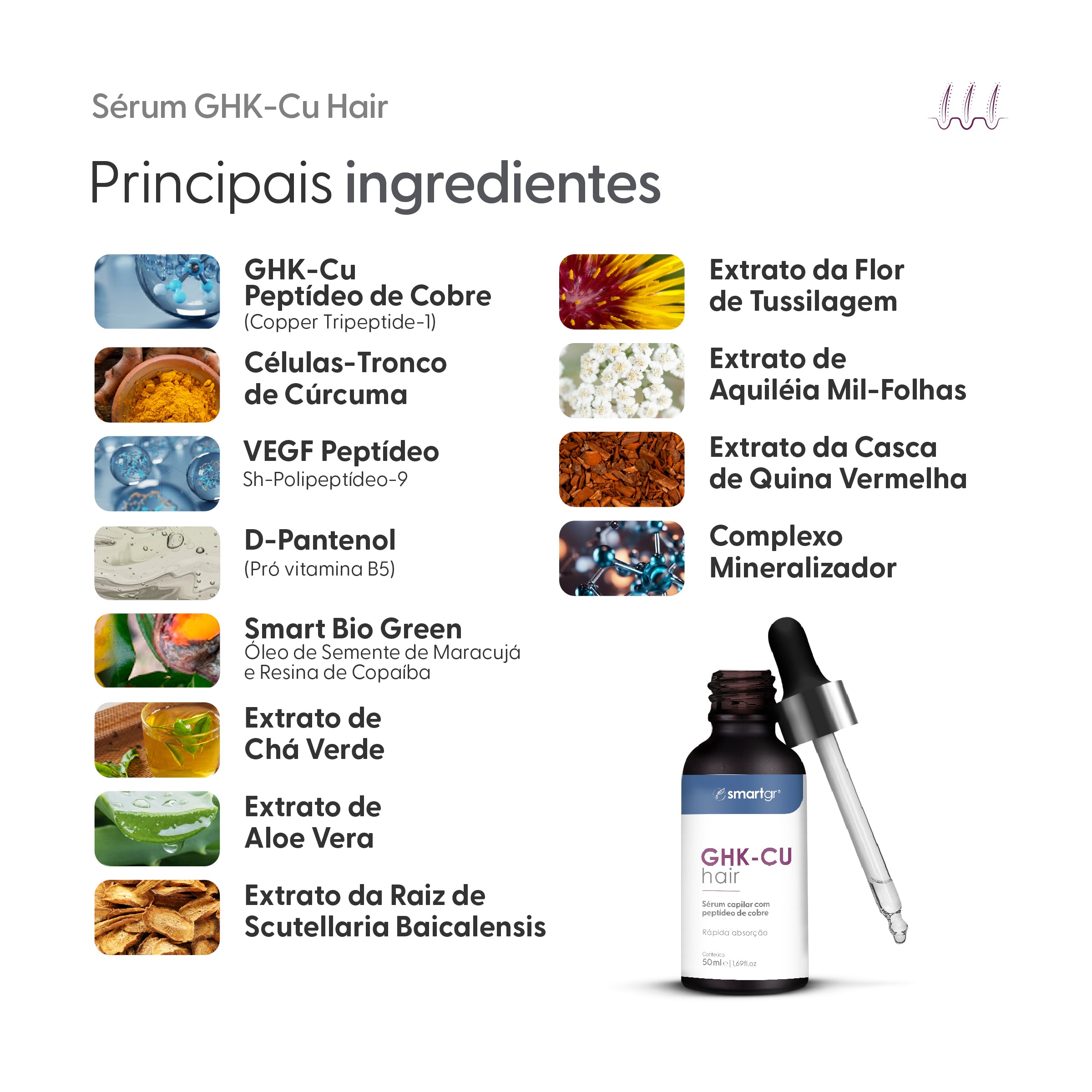
All claims are sourced to published research or clearly labeled as mechanistic inference. Large-scale human RCTs specifically for hair growth are lacking, but the mechanistic basis is well-supported in the published literature. GHK-Cu shows promise for hair growth by enlarging follicle size, increasing follicle blood supply, and upregulating hair growth factors (VEGF, KGF).
Pharmaceutical-grade compounded peptides and medical oversight are necessary for subcutaneous GHK-Cu, which has shown a positive safety profile based on its mechanism and available data. With an impressive safety record from decades of use and numerous clinical trials, topical GHK-Cu’s primary adverse effect is mild irritation in sensitive individuals. There is no FDA-approved standard dosage for subcutaneous administration; clinical protocols rely on research literature and the experience of physicians. For topical application (initial enhancements in skin texture and hydration can be anticipated within 4–6 weeks), with noticeable improvements in fine lines and laxity observed after 8–12 weeks of consistent twice-daily use.